Unlocking Creative Process: The Versatile Power of Mountain Landscape Junk Journal Pages
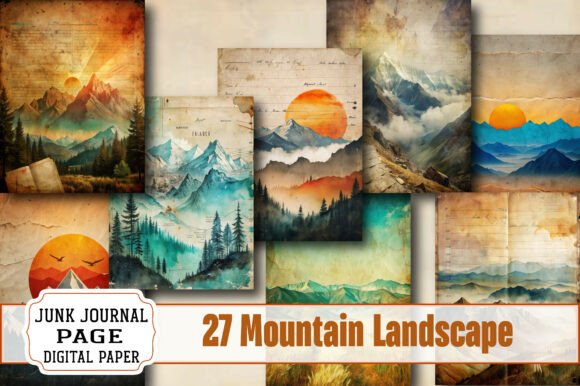
In the vast ecosystem of digital assets for creators, a specific category stands out not for being a singular tool, but for acting as a foundational component across myriad workflows. Mountain Landscape Junk Journal Pages represent a curated set of high-resolution graphic elements centered around serene, natural vistas. They are not merely images; they are modular, adaptable raw materials designed for integration into a creative or professional process. Their primary function is to serve as a consistent visual starting point, eliminating the initial friction of asset creation and allowing you to focus on execution, assembly, and customization.
Integrating Visual Foundations into Your Workflow
Whether you are a hobbyist crafting a personal junk journal or a small business owner designing product labels, your process typically begins with a visual direction. Searching for disparate, license-compatible images consumes time and can lead to inconsistent results. Mountain Landscape Junk Journal Pages solve this by providing a coherent thematic library. The workflow integration happens at the preparation stage. Before you open your design software or pick up your glue for decoupage, you have already downloaded this digital pack. This pre-selection establishes your project's aesthetic tone—rustic, tranquil, adventurous—streamlining subsequent decisions about color palettes, complementary fonts, and additional embellishments.
A Cross-Disciplinary Asset for Diverse Applications
The true measure of a digital asset's utility is its compatibility across different mediums and end-products. The Mountain Landscape Junk Journal Pages are engineered for this cross-platform use. The high-resolution 300 DPI JPG format ensures professional print quality for physical items like greeting cards, invitation suites, and tumbler wraps, while also remaining perfectly suitable for digital outputs like website graphics or social media backgrounds. This dual compatibility means you can maintain brand or project consistency across both tangible and digital touchpoints. For instance, a blogger can use the same mountain scene for their printable journaling pages, their YouTube channel background, and the promotional gift tags for a subscriber giveaway, creating a unified visual identity.
Practical Implementation in Creative and Business Projects
Consider the process of a freelance graphic designer tasked with creating a complete stationery suite for a outdoor retreat center. Instead of commissioning custom illustrations or purchasing multiple, costly stock photo licenses, the designer can leverage the Mountain Landscape Junk Journal Pages pack as the core visual element. The workflow would involve:
- Resizing and cropping specific elements from the pages for different applications: a panoramic view for the website header, a smaller detailed peak for the logo watermark, and a textured section for the background of the digital planner covers offered to guests.
- Layering and combining with other design elements. The pages act as the base layer. Text for invitations, logistical details for the digital planner, and branding for soap labels are overlaid, ensuring the natural theme remains dominant.
- Iterating quickly across formats. Because the core asset is consistent, creating variations for A7 greeting cards, party napkins, or large format posters becomes a matter of layout adjustment rather than sourcing new imagery.
This implementation dramatically reduces project lead time and ensures a cohesive final product. For the productivity-minded user, such as an educator creating themed lesson materials, the pages offer a ready-made decorative element for worksheets, presentation slides, and classroom decoration posters, allowing focus to remain on content development rather than graphic design.
Enhancing Quality Control and Long-Term Usability
A common hurdle in long-term projects or recurring business needs is maintaining quality and consistency. Using a haphazard collection of images from various sources often leads to visual drift. Integrating a dedicated asset pack like Mountain Landscape Junk Journal Pages into your organizational system acts as a quality control measure. By returning to the same source library for subsequent projects—be it the next junk journal volume, a new product line label, or a seasonal social media campaign—you guarantee a recognizable style. The high-resolution format also ensures longevity; as you resize for different needs, from playing cards to wall art prints, the images retain their clarity and professional appearance, protecting the perceived value of your end products.
Streamlining the Execution Phase
The actual execution of a craft or design project is where these pages prove most practical. For the collage artist or decoupage enthusiast, the process moves directly from concept to hands-on creation. The pages are printed, cut, and assembled without the intermediate step of evaluating image quality or suitability. In digital design workflows, the pages are imported as layers into software like Photoshop, Canva, or Affinity Designer. Their uniform theme and resolution mean less time spent on corrective adjustments for brightness, contrast, or thematic mismatch. This allows you to allocate more time to the nuanced aspects of your project: perfecting the copy on your wedding invitations, engineering the layout of your KDP book cover, or coding the interactive elements of your website where the mountain landscape serves as the backdrop.
- For crafters: The pages are a physical substrate. They become the pages of a handmade notebook, the base for a wind spinner decoration, or the material for gift tag assembly. Their aesthetic cohesion means the final crafted item feels intentionally designed, not randomly assembled.
- For digital entrepreneurs: They function as a swift prototyping tool. Mocking up a mug design, a phone case graphic, or a set of digital planner covers for market testing can be done rapidly using elements from the pack, accelerating the feedback loop before final production.
Observations on Efficiency and Adaptability
A key observation from using such multi-purpose digital packs is the efficiency gain in asset management. Instead of maintaining folders of unrelated images for different project types, you consolidate your resource needs. The "resize to suit your needs" specification is particularly crucial for process integration. It means one asset can flow through multiple software tools and output specifications without requiring a separate, resized version for each. You prepare the asset once in your preferred dimension, and that prepared file can be reused in the sticker cutting software, the sublimation transfer design template, and the mockup for packaging. This adaptability reduces file management overhead and minimizes the risk of using a low-resolution version for a high-resolution need.
Ultimately, Mountain Landscape Junk Journal Pages are a process-oriented solution. They fit into your workflow not as the final product, but as the high-quality, versatile ingredient that enables you to execute your vision—whether it's a personal creative expression, a professional client project, or a branded business output—with greater speed, consistency, and focus on the unique aspects that make your work distinct.