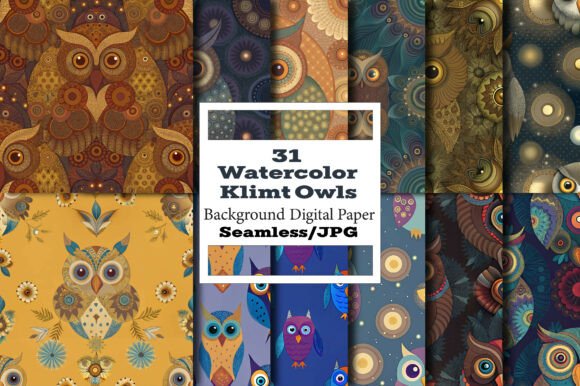
The Allure of Watercolor Klimt Owls Seamless Patterns
If you’ve stumbled upon a "Watercolor Klimt Owls Seamless Pattern," you’ve discovered a unique artistic blend. This design merges the rich, decorative elegance reminiscent of Gustav Klimt’s iconic artwork with the whimsical charm of owls, all rendered in a soft, flowing watercolor style. The "seamless" aspect means the pattern tiles perfectly, creating an infinite background without awkward breaks. This makes it incredibly versatile for personal projects and commercial endeavors, from DIY crafts to professional product branding.
Its appeal spans a broad audience. Hobbyists love its aesthetic for handmade gifts; entrepreneurs see its potential for creating unique merchandise; digital creators use it for captivating social media graphics. However, diving in without some practical forethought can lead to frustrating outcomes. The key to success lies not just in appreciating its beauty but in understanding how to properly utilize it.
Common Missteps and How to Navigate Them
Even with a high-quality digital asset, a few overlooked details can undermine your efforts. Here are some areas where people often stumble and how you can avoid them.
Ignoring File Specifications and Application Fit
A common oversight is assuming any pattern file is suitable for any project. The Watercolor Klimt Owls Seamless Pattern is often provided as a high-resolution JPG. While "300 DPI" is excellent for printing, using it for a large format, like a website background banner, requires checking the actual pixel dimensions. If the file is 5000x5000 pixels, it’s great for a physical tote bag but might stretch poorly or lose quality if enlarged further for a massive wall mural print.
Better approach: Always match the file's native dimensions to your project's size needs. For digital uses like social media backgrounds, you can often resize down without issue. For physical prints, especially large ones, ensure the DPI remains adequate at the final print size—a 300 DPI file printed at 10 inches is fine, but printed at 30 inches might drop effective DPI to 100, causing blurriness.
Misunderstanding "Seamless" Application
The seamless feature is a powerhouse, but misapplying it can break the visual flow. A mistake is placing a cut-out portion of the pattern onto a project without considering the tile edges. For instance, if you’re designing a tumbler wrap and only use a small rectangle of the pattern, you might inadvertently include a harsh line where the pattern repeats, making the wrap look patchy instead of continuous.
Better approach: Use software that supports seamless tiling (like most graphic design programs). Apply the pattern as a fill to the entire shape or canvas, letting the software handle the seamless repetition. For physical crafts like decoupage, plan your cuts to overlap pattern repeats gently or use areas where the design naturally flows without obvious repetition boundaries.
Overlooking Color Mode and Background Integration
This pattern typically comes on a white or transparent-like background in JPG format. A frequent error is trying to layer it over a dark-colored project without adjusting the artwork. Simply placing the white-background JPG onto a dark mug design for sublimation will result in an obvious white rectangle around the owls, ruining the integration.
Better approach: For projects requiring true transparency (like overlays on colored website graphics), you might need to use the pattern in a software that allows you to remove the background or confirm the file has a transparent PNG version available. For sublimation on dark fabrics, remember sublimation inks dye the fabric; a white background in the design will result in no ink transfer, leaving the fabric’s original color (often dark) as the "background," which can look intentional if the design is prepared with that expectation.
Essential Checks Before You Start Your Project
To ensure your project shines, perform these practical checks before downloading or using the pattern.
Verify the Final Use and License Scope
While many such patterns are sold for commercial use, always double-check the license. Does it allow you to create physical products for sale, like personalized pillows and tote bags? Can you use it in digital products for KDP (Kindle Direct Publishing)? Assuming broad use without verification can lead to legal complications.
Practical advice: Read the product description carefully. Look for terms like "commercial use," "no resale of the digital file," or "personal use only." If it’s unclear, contact the seller before proceeding with a commercial venture.
Assess the Pattern’s Detail Scale for Your Medium
The intricate Klimt-style details and owl features are beautiful, but they might not translate well to very small-scale applications. Using it for tiny party napkin prints or small soap labels could make the detail muddy and unrecognizable.
Better choice: Test a small area first. Print a sample at the intended size. If the owls’ eyes and decorative elements become blurry blobs, consider using a simplified section of the pattern or opting for a different, less detailed design for those particularly small items. The pattern might be perfect for larger notebook covers or pillow designs where the detail can be appreciated.
Plan for Color Consistency Across Products
If you’re using the Watercolor Klimt Owls Seamless Pattern for a cohesive brand or event (like a wedding or baby shower suite including invitations, plates, and website graphics), a mistake is not accounting for color variation across different printing methods. Sublimation on a mug, digital printing on paper, and screen printing on a t-shirt can all render the watercolor hues slightly differently.
Practical advice: Work with a professional printer or test print on various mediums. Provide them with the original high-res file to ensure they use the same color source. For digital-only uses, the colors will remain consistent, but for physical products, expect and accept some minor, natural variation due to the process.
Embracing the Pattern for Maximum Creative Impact
When used thoughtfully, this pattern can elevate your work. Its artistic heritage offers a touch of sophistication, while the owl motif adds a playful, trendy element. Avoid the pitfalls of mismatched scaling, poor integration, and license ambiguity by taking a moment to plan. Whether you’re crafting mini junk journals, designing trendy social media backgrounds, or producing a line of cute tote bags, respecting the technical aspects of the digital asset will let the beauty of the Watercolor Klimt Owls Seamless Pattern truly shine through in your finished creations. Start with clarity on your project’s requirements, and you’ll transform this versatile pattern from a simple download into the cornerstone of something uniquely yours.